The Pearl Strand Planner
Take the length from the wearer, count the pearls at both ends of the size band with the knots and clasp included, and check a seller's length, count and weight agree before you pay
JewelPearl's free calculators each answer one pearl question. The Necklace Length Calculator answers in inches and the Pearl Strand Calculator asks for millimetres; the Pearl Size Recommender gives a range and the strand calculator takes one size; and the strand calculator starts with no knots and no clasp, so its own FAQ counts 64 pearls of 7 mm in "about 450 mm" for an 18-inch strand. A true 18 inches, knotted, with a clasp, holds 57. Nothing turns a seller's length, size band, pearl count and weight back into a check that they agree. The Pearl Strand Planner joins the tools. On a worked example, a 158 cm wearer's princess length is 17.5 inches, exactly 444.5 mm; a 7.0 to 7.5 mm strand of it, knotted at a measured 0.8 mm with a 10 mm clasp, holds 55 pearls if they run small and 52 if they run large, and 58 to 61 loose pearls cover drilling and matching. Checked the same way, an 18-inch 7.0 to 7.5 mm listing claiming 60 pearls implies pearls of 6.65 mm, and its stated weight says 6.9 mm: both below the band. An unknotted 16-inch strand restrung with knots grows 44.8 mm, from choker to princess, unless 6 pearls come off. Pearl counts are estimates (pearls in a band vary, and knots vary with the silk), and the weight check assumes round pearls. It is not an appraisal: it never prices or values a pearl, and it says plainly that grading systems differ between labs and sellers. Pearl necklaces are not for babies or toddlers. Included: 7 steps, a strand plan, a listing check, a grading scorecard that travels between sellers, a restring and care record, a pearl-count table and a quickstart, 24 printable pages. Arrive from a calculator and you also get a personalised sheet worked on your own numbers.
Look inside
Two full pages from the planner, exactly as printed. Click either to read it at full size before you decide.
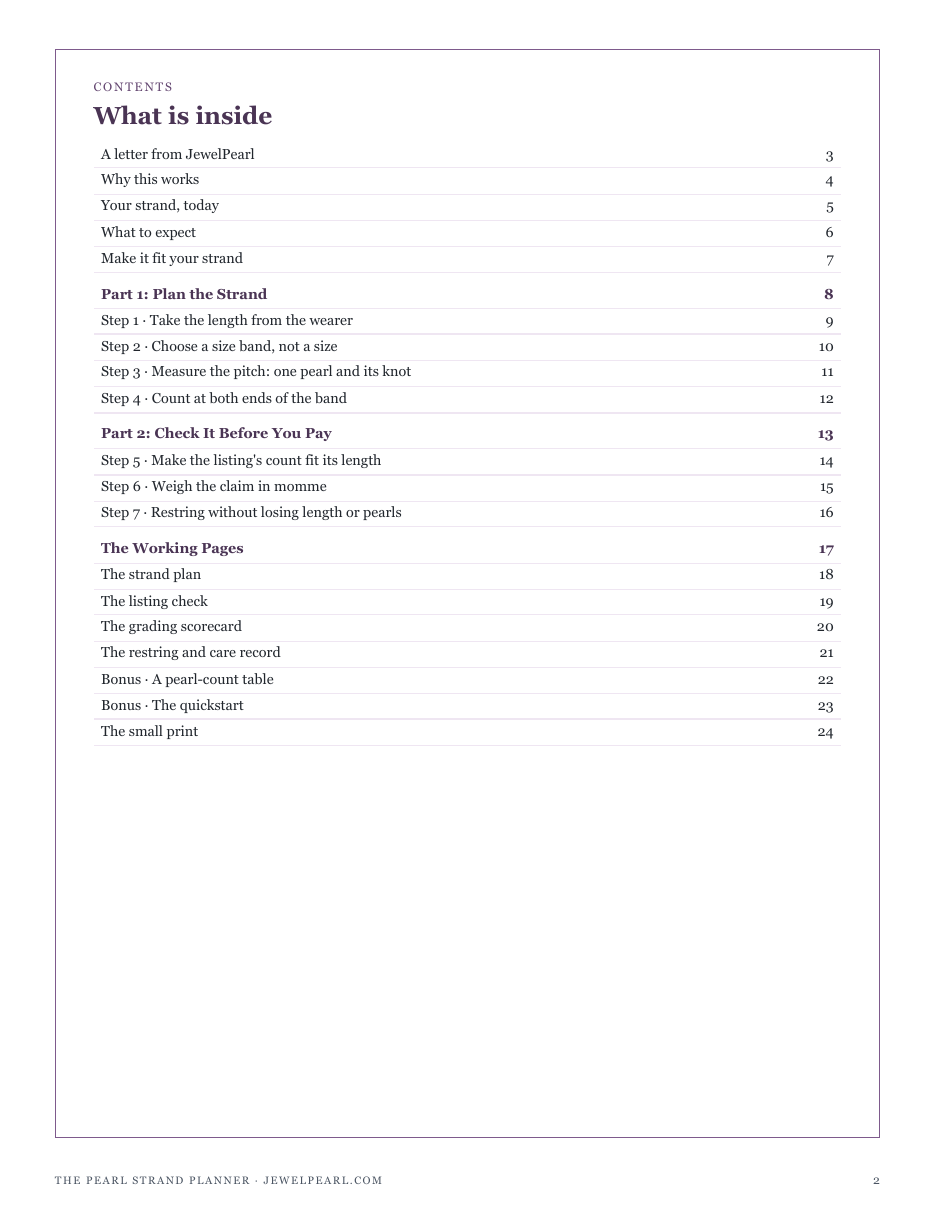
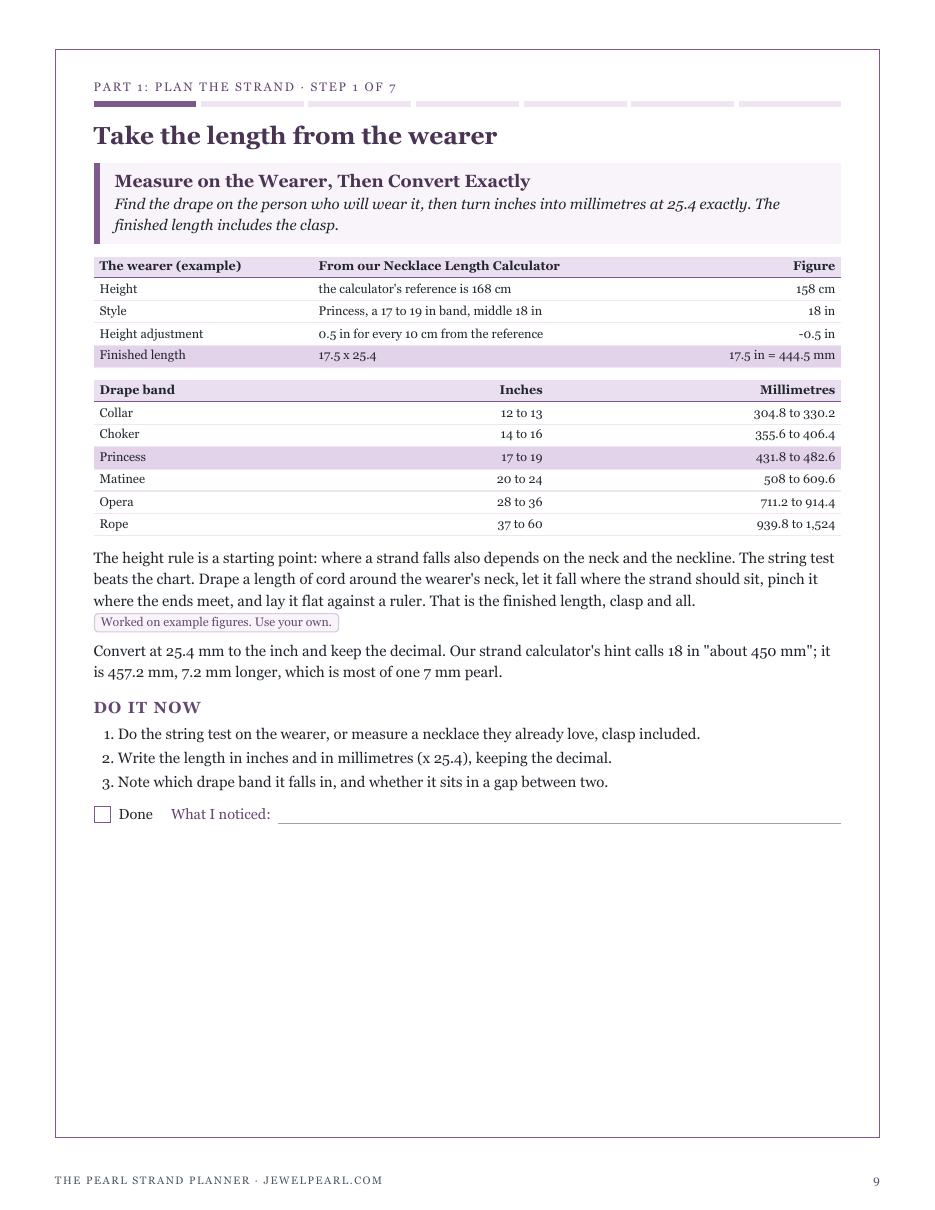
What is in it
- Measure on the Wearer, Then Convert Exactly: the length from the wearer's height and a cord, every drape band in inches and millimetres
- A Size Is a Band, Not a Number: a half-millimetre band inside the recommended range, and the line on children
- Count by the Pitch, Not the Pearl: measure ten pearls and their knots, and what knotting costs in pearls
- Two Ends, Two Counts: the pearl count at both ends of the band, the finished length at that count and one more, and loose pearls with a cushion
- The Count Must Fit the Length: the implied pearl size from any listing's length and count, and the knot its claim needs
- Weight Is a Second Witness, Not a Verdict: a strand's weight in momme turned into a pearl size, beside the count's
- Count Before You Cut: what knots do to a strand you restring, and the care that keeps it strung
- The strand plan and the listing check, printable
- A grading scorecard that travels between sellers, and a restring and care record, printable
- A pearl-count table for eight sizes and five lengths, and a one-page quickstart
- ✓ 24 printable pages
- ✓ 10 sections, worksheets and templates
- ✓ A second PDF worked out from the numbers you enter
- ✓ No account needed, just an email address
- ✓ Instant download; link valid 7 days
Price includes any taxes. Sold by GrabURL, who handle checkout and support. The charge appears on your statement as GrabURL.
The planner picks up where the free Pearl Strand Length & Bead Count Calculator leaves off. The calculator counts the pearls in one length at one pearl size; the planner takes the length from the wearer with the Necklace Length Calculator, converts it to millimetres exactly, counts at both ends of a size band from the Pearl Size Recommenderwith the knots and the clasp included, and checks a seller’s length, size band, pearl count and weight against each other with the Pearl Momme Calculator. Pearl counts are estimates: pearls in a band vary, and knots vary with the silk. It is not an appraisal and never prices or values a pearl; grading systems differ between labs and sellers, and the scorecard in it is a self-assessment. Pearl necklaces are not for babies or toddlers: a necklace is a strangulation hazard and a loose pearl a choking hazard. The worked figures are examples.